 St. Peter’s church Buntingford, as well as a place of worship, has the honour of being the second oldest brick-built church in the country (built between 1614-1626). Whilst it is grade 2 listed, in my humble, non-architectural opinion, it isn’t a particularly impressive building (but of course that’s not important, a church being the people). However nestling up in the eves, where the outside vertical walls meet the roof, a feral colony of bees has existed for at least two years. How do I know this? Well for the past two years it has thrown (technical term) a number of swarms into the same two gardens that are a short distance away.
Last year one elderly resident paid for a pest controller, who rather sadly destroyed the swarm. This year, £40 lighter in the pocket he could no doubt ill afford, the same owner asked the church to remove the source. Unfortunately removing bees from a building fabric is not easy, especially when it’s a listed building and thirty or forty feet in the air. Unless you can access the actual nest, involving the removal of roof tiles and goodness knows what else, bees leaves behind wax, honey and young bees (brood), which attracts wax moth and the next swarm that passes by. Much better to leave them if possible, as bees will not cause damage to the fabric, unlike wasps. Therefore as a compromise I offered to remove any swarms for free that ventured near his garden. Little did I know what excitement was in store!
Two weeks ago I got a call from Chapel end adjacent to the church, to say a swarm had landed in a bush in a neighbours garden. Easy-peasy I thought. How wrong I was. Three nights later I finally managed to persuade HRH and her entourage to enter a small hive with some added honey as a treat, having tried unsuccessfully each evening on three successive days to shake, cajole or otherwise without damaging said bush. Mission accomplished?
This week yet another swarm emerged from the same ecclesiastical source, this time into the “wrong garden”, hanging from a clematis. Whilst at a height that wouldn’t require me swinging from a ladder, bees being bees they decided to spread themselves along a 15 cm section of stem and leaf. I was able to shake some into my straw basket (skep), but the remainder proved elusive. Brushing them wasn’t effective, bees flying off and then relanding in the same place. How could I collect them? Then I struck on an idea. Bees will naturally walk uphill, so I held my skep with some bees above the remaining cluster and blow me, they started to walk, even run, up into it!
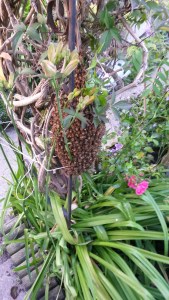
I took a video, because I didn’t think you’d believe me. See it here.
Having got 70% of the cluster into the skep I placed it five feet away, on an old spread out sheet, and soon bees were fanning their Nazanov glands, sending out welcoming pheromone scents to their sisters (and some brothers) to come and join them. Amazing. Within 45 minutes all the bees had moved into the skep, sheet wrapped over and I was then able to move them to their new home a couple of miles up the road.
Those of you with some knowledge of honey bee biology are wondering why a colony has thrown two swarms in a week and how is it possible? Well when bees are cramped in their colony this stimulates them into making new queen cells. But they don’t just make one, they can make dozens, all from different ages of larvae. When the first queen cell is sealed, at nine days, the old queen leaves with a large percentage of the foraging bees. This is the primary swarm, which can be enormous. However new queens are emerging at a rate from day sixteen and contrary to popular belief the first queen doesn’t always go around destroying her sisters, but may leave the colony in a smaller “cast” swarm. 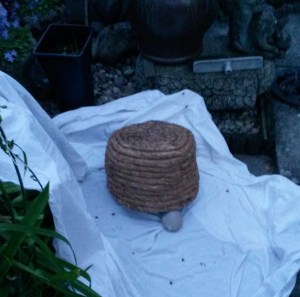 The queen will be a virgin. These swarms are less likely to survive, but I’ve always assumed it is the bees “just making sure. Soon the swarm were safely tucked up in their new polynuc. But that wasn’t the end of the story.
A week later, whilst driving back from Leicester, I took a call (hands-free) from the same elderly resident. Guess what? Yet another *swarm in an identical location! Unfortunately by the time I was home they had flown, but what attracts bees to the same swarming site? I had the same thing a few years ago when a swarm went into the same garden compost bin two years running. Some have suggested Ley lines. Whilst I’m a believer in an almighty creator God, I’m less sure about lines that criss-cross the planet connecting places of geographical interest. However a very well respected beek, who also dowses, says he checks every time he takes a swarm and there is always a Ley line involved. Reckon he might have caught a bit too much sun or is there a connection?
*may not have been from the church colony
 Welcome to Buntingford Bees
I just left a comment, but it may not have arrived because I didn’t click on post comment? Can you let me know please – I’ll redo it if it didn’t arrive!
LikeLike
Your comment was”I’ve just left a comment, but it may not have arrived because I didn’t click post comment.” Ha ha. Perhaps try again? 🐝
On Fri, 23 Jun 2017 at 10:44, Welcome to Buntingford Bees wrote:
>
LikeLike