The first inspection in spring is always eagerly anticipated by beeks. Weather forecasts are scanned for weeks beforehand, a sense of anticipation builds on the online forums, pieces of seaweed hung up on nails and pine cones studied until the temperature creeps above 13oC. The rule of thumb is when it is warm enough to go outside in your shirt sleeves, you can carry out the first inspection. Today was such a day!
All my colonies survived winter and have been eagerly bringing in bright yellow pollen from the local willow trees and more recently orange / yellow as the first dandelions poke their heads up through the earth. However today was the first peak into the brood boxes. These are the larger boxes where the queen lays her eggs, which then undergo a truly miraculous transformation over the next 21 days until they emerge as a young adult worker bee (or 24 days if you’re a blokey drone).
Some hives were stronger than others, with three colonies having 7 or 8 (from 11) frames of brood! It’s only March. These needed a second brood box added, with more space for the queen to lay, as I like to build strong hives for the late spring / early summer honey flow and to prevent congestion, a factor in swarming, which we want to avoid. Very early season indeed.
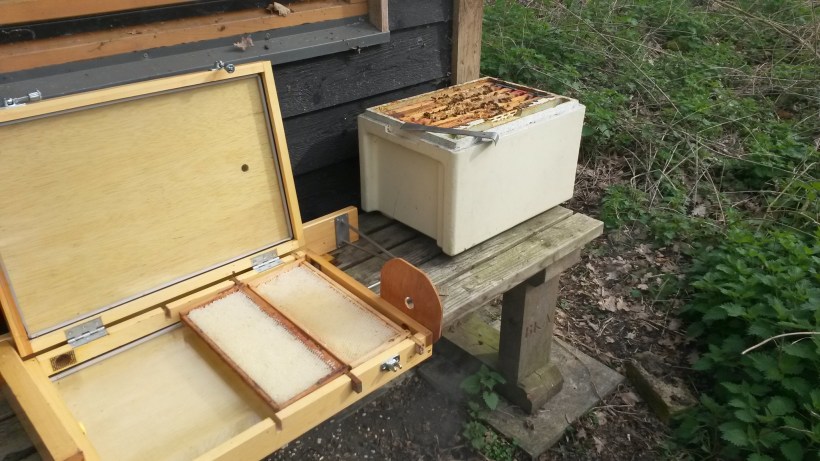
Having inspected my hives I went off to Westland Green, where the Association apiary is housed. My job was to set up an observation hive to help a researcher Liz and her PhD project at Royal Holloway College. Liz is studying the waggle dances of bees in London and rural areas, to understand the distances bees have to travel to forage and to see if there is a difference between urban and rural areas. Liz goes to Westland Green and countless other places, to film the bees in the OH. The videos are then analysed and deciphered by clever computer algorithms to show travel distances. Liz will be studying the bees throughout the summer.
You can see the observation hive (OH), which looks like a giant book, hinged on one side. The photo shows the hive before any bees are added from the small nucleus (nuc) on the right.
 Welcome to Buntingford Bees